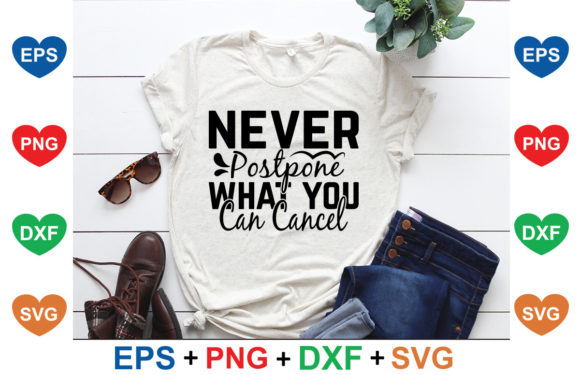
Never Postpone What You Can Cancel
A Design That Speaks Before the Needle Moves
First glance at Never Postpone What You Can Cancel isn’t about cuteness or complexity—it’s about presence. Clean lines, confident spacing, and a quiet kind of wit make it land like a well-placed stitch: precise, intentional, and impossible to ignore. As a designer who’s stitched hundreds of text-based graphics for real clients—from boutique aprons to baby onesies—I immediately saw its rhythm: short enough to read at a glance, sharp enough to hold weight on fabric. It doesn’t scream. It leans in.
Where This Design Actually Lives Well
I recently tested Never Postpone What You Can Cancel as the centerpiece for a custom embroidered canvas tote—intended for a local wellness studio’s staff gift. The design sat cleanly centered on the front panel, sized to 4.2" wide. On medium-weight natural canvas with tear-away stabilizer and 40-weight polyester thread, every letter held its shape. No bleeding, no skipped stitches, no awkward gaps between “C” and “a” in “Cancel.” That matters—because when you’re stitching for a small shop or Etsy seller, clarity builds trust. Customers don’t just buy a tote; they buy intention, and this phrase delivers it without irony or clutter.
It also works beautifully on relaxed-fit sweatshirts (especially charcoal or oatmeal), where the slightly bolder weight of the letters reads clearly even from across a room. I tried it on a curved cap front too—scaled down to 3.5"—and while it required careful hooping and medium-cutaway stabilizer, the result was crisp and professional. For baby embroidery? Use it sparingly: best on crib blankets or muslin pillow covers—not onesies, where tiny letterforms risk looking cramped or fragile.
Where to Pause—and Why
This isn’t a one-size-fits-all embroidery file. Its strength is in simplicity, but that means detail tolerance is low. On thin fabrics like lightweight cotton voile or stretchy jersey tees, I’d avoid it unless paired with firm cutaway stabilizer and reduced stitch density (if your software allows). Tiny serifs or tight corners—like the tail of the “g” in “Cancel”—can blur or feather if tension isn’t spot-on or if thread color lacks contrast against the background.
Dark fabric demands attention: test it in black-and-white mockups first. On navy or black, light thread (ecru, soft white, pale gray) gives warmth without glare; neon or metallics feel off-brand here. And skip it on textured surfaces like bouclé or heavy terry cloth—unless you’re willing to layer stabilizer generously and accept some softening of edges.
What It Adds—Beyond the Stitch
Never Postpone What You Can Cancel elevates more than just fabric—it lifts the perception of your handmade product. When stitched cleanly on a linen tea towel or minimalist pillow cover, it signals thoughtful curation, not mass production. Buyers notice that. On Etsy listings, it performs strongly in search for “minimalist embroidery quote” or “witty tote bag design,” especially paired with clean lifestyle photos and honest descriptions.
For craft fair sellers or small shop owners, it’s a subtle brand amplifier—ideal for merchandise that reflects values over volume. A customer who chooses this phrase isn’t buying decor; they’re aligning with an ethos. That resonance translates directly into repeat engagement, better reviews, and stronger word-of-mouth.
Real Designer Notes—Before You Hoop It
- Always test on scrap fabric first—especially if using textured, dark, or stretchy materials.
- Check thread color contrast before stitching full production runs. A muted sage on cream reads differently than the same thread on charcoal.
- Review stitch density in your embroidery software. If the fill areas look overly dense, reduce density by 5–10% to prevent puckering on lighter weaves.
- Confirm hoop size compatibility. While the ZIP includes SVG, EPS, PNG, and JPG files, only the embroidery-ready format (if included) will specify actual stitch count and hoop requirements—so verify what’s inside before digitizing or outsourcing.
- Inspect small details at 200% zoom in your design software—look for stray anchor points, overlapping paths, or ungrouped elements that could cause misalignment.
- Test in black-and-white mockups to assess legibility across backgrounds. Does it disappear on light grays? Get swallowed on heathered fabric?
- Use proper stabilizer: medium tear-away for stable wovens, cutaway for knits or delicate surfaces.
- Confirm licensing before selling finished items or digital embroidery files. Since this is listed as a Graphics file under T-Shirt Designs, clarify whether commercial use is permitted—and whether resale of stitched products requires attribution or restrictions.
Final Thought: Not Just a Phrase—A Filter
Never Postpone What You Can Cancel isn’t just another machine embroidery design. It’s a filter—for projects, for clients, for your own creative energy. It fits naturally on pieces meant to be seen, held, and lived with: kitchen towels hung in view, tote bags carried daily, pillow covers that anchor a room. It doesn’t beg for attention—it earns it through restraint and resonance.
If you’re choosing embroidery files for your craft business, Etsy shop, or custom apparel line, ask yourself: does this design reflect the care my customers expect? With Never Postpone What You Can Cancel, the answer—when executed well—is yes. Just remember: the phrase only lands when the stitch does too.