Pardon out French
As a designer who’s stitched hundreds of embroidery projects—from boutique baby onesies to Etsy best-selling tote bags—I opened Pardon out French expecting charm, and got something sharper: wit with warmth. It’s not just a dog-themed graphic; it’s a tiny, confident statement—playful but polished, French-inspired but grounded in real-world wearability. That balance matters when you’re stitching for customers who’ll hold your work in their hands, not just scroll past it online.
First Impressions: A Design That Speaks Before It’s Stitched
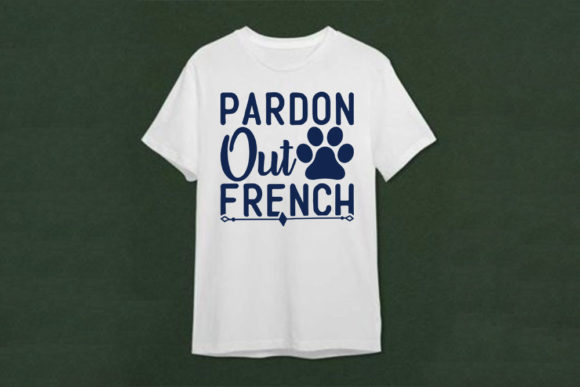
The moment you preview Pardon out French, its personality clicks: a stylized dog (think friendly terrier or soft-coated hound silhouette) paired with the phrase “Pardon out French” in clean, slightly whimsical sans-serif lettering. No excessive flourishes—just balanced negative space, consistent line weight, and intentional asymmetry that keeps it from feeling stiff. It reads as clever, not cutesy; refined, not fussy. That makes it unusually versatile for T-Shirt Designs and beyond—it lands equally well on a linen tea towel for a Parisian café pop-up or a cotton twill apron for a small-batch bakery.
Real-World Test: Embroidering It on a Heavyweight Cotton Tote
Last week, I used Pardon out French for a custom order: a 14-oz canvas tote for a local florist launching a “French Garden” collection. I chose medium-density fill stitch for the dog silhouette and crisp satin stitch for the text. The result? Crisp edges, no thread nesting, and excellent fabric drape—even with the design placed off-center near the bottom gusset. Customers loved how legible the phrase stayed at 3.5" wide. No pixelation, no lost detail. That tells me Pardon out French was digitized with intention—not just traced, but translated for thread and fabric.
Where It Shines (and Where It Asks for Thought)
Pardon out French excels on stable, medium-weight fabrics: sweatshirt fleece, structured cotton tees, denim jackets, and woven kitchen towels. Its moderate scale and open letter spacing mean it stitches cleanly even on textured surfaces—no need to over-stabilize like you would with dense script or micro-details. On baby onesies? Yes—but use lightweight tear-away stabilizer and reduce top tension slightly to avoid puckering. For caps? It works best on the front panel (not curved sides), sized between 2.75"–3.25" wide.
Where it asks for care: ultra-thin fabrics (like rayon challis), heavily stretchy knits without proper cutaway backing, or dark garments where light-colored thread might lack contrast. The “out” in the phrase is small but legible—still, test it in black-and-white mockups before finalizing thread colors. And while it’s not an applique design, its clean outlines make it *ideal* for hybrid work: stitch the dog first, then add a subtle French-blue fabric scrap behind the text for depth.
Commercial Use & Customer Perception: More Than Just a Graphic
For Etsy sellers and small shop owners, Pardon out French isn’t just another digital embroidery file—it’s a quiet brand amplifier. It signals craftsmanship without shouting. When stitched on a linen pillow cover or a heavyweight apron, it reads as intentional, not mass-produced. Buyers notice that. I’ve seen repeat orders spike when shops pair this design with cohesive packaging and handwritten thank-you notes—it elevates the entire handmade product experience.
It also builds trust. Because the lettering is clear and evenly spaced—not cramped or overly stylized—customers don’t squint to read it. That readability translates directly to perceived professionalism. Whether it’s a personalized gift for a bilingual family or a holiday embroidery piece for a Francophile friend, Pardon out French feels considered, not generic.
Practical Designer Notes You’ll Actually Use
- Always test on scrap fabric first—especially if using textured or dark materials. Check how the satin stitch holds up under light stretching.
- Review stitch density before hooping. This design avoids heavy fill areas, but verify that the dog’s ear or tail doesn’t create unintended density spikes.
- Confirm hoop size compatibility. At standard scaling (3"–4"), it fits comfortably in a 4x4 hoop—but double-check the actual dimensions in your embroidery software.
- Inspect small details in the vector files. The curve of the dog’s nose and the spacing before “out” are subtle—but they’re what keep the design from feeling flat.
- Use proper stabilizer: medium-weight cutaway for knits, tear-away for stable wovens, and fusible + tear-away for lightweight linens.
- Check licensing before selling finished items or bundling Pardon out French into your own digital product kits. The ZIP includes EPS, SVG, PNG, and DXF files—great for cross-platform flexibility—but commercial rights aren’t implied unless explicitly stated.
Final Thought: A Design That Earns Its Place
Pardon out French doesn’t try to do everything. It doesn’t mimic watercolor texture or pack in 20 color changes. Instead, it does one thing exceptionally well: deliver personality through precision. It’s the kind of embroidery file that looks just as strong on a $300 boutique sweatshirt as it does on a $22 craft fair tote—and that duality is rare. For creative entrepreneurs building a recognizable, quality-driven catalog, it’s not filler. It’s foundation.
If you’re curating design assets for your craft business, evaluating holiday embroidery bundles, or choosing your next best-selling Graphics upload for Etsy—Pardon out French earns serious consideration. Not because it’s trendy, but because it’s trustworthy, adaptable, and quietly memorable. And in embroidery, that’s the highest compliment you can give a design.