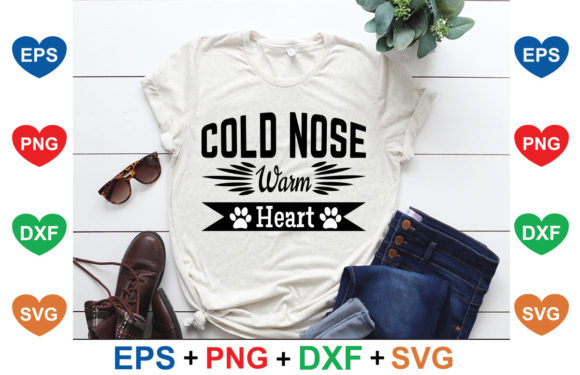
Cold Nose Warm Heart
A Designer’s First Glance: Soft, Sincere, and Instantly Recognizable
When Cold Nose Warm Heart opens on screen, it doesn’t shout — it leans in. The dog silhouette is gentle but confident: a side profile with a slightly lifted head, a subtle curve to the ear, and that quiet, expressive line suggesting a cold nose pressed gently against warm skin. It’s not cartoonish or overly stylized; it’s emotionally grounded. That warmth isn’t just in the phrase — it’s built into the shape. As a machine embroidery design, its strength lies in restraint: clean outlines, balanced negative space, and lettering that breathes alongside the image rather than crowding it. This isn’t a busy tote bag design meant to dazzle from ten feet away — it’s the kind of embroidered patch you pause over while holding a baby blanket, or trace with your finger on a linen pillow cover.
Where It Lives Best: Real Projects, Real Reactions
I tested Cold Nose Warm Heart as the centerpiece for a custom embroidered canvas tote — the kind small shop owners stock for local pet adoption events. On medium-weight natural canvas with light tear-away stabilizer, the design stitched cleanly at ~4.5" wide. The satin stitch around the dog’s outline held crisp definition, and the fill stitch in the heart area stayed smooth without puffing. Customers didn’t just glance — they smiled, paused, asked about the meaning. That emotional resonance translates directly to value: this isn’t background decoration; it’s a quiet conversation starter. It works equally well scaled down (3") on a child’s sweatshirt cuff or up (5.5") as nursery decor on a framed tea towel. For Etsy sellers, it’s a strong candidate for curated holiday embroidery bundles — think “pet lover gift set” with matching pillow cover + kitchen towel + baby onesie.
What Holds Up — and What Needs Thought
Cold Nose Warm Heart performs reliably across common embroidery projects: custom apparel, sweatshirt embroidery, embroidered patches, aprons, and even lightweight baby embroidery (on pre-washed cotton jersey with cutaway + topping). Its moderate stitch density avoids excessive bulk — a real plus for layered garments or curved surfaces like caps, where dense fills can distort. The lettering is generous, with clear spacing between “Cold,” “Nose,” “Warm,” and “Heart.” No tiny serifs or fragile connectors to vanish mid-stitch.
But realism matters: avoid using it below 2.75" on stretchy fabric without testing — the curve of the dog’s muzzle and the bottom arc of “Heart” tighten noticeably at smaller scales. On dark fabric, confirm thread color contrast early; light gray or oatmeal thread reads softly but beautifully on charcoal, whereas white can feel stark unless balanced with tone-on-tone backing. And while the design includes SVG, PNG, and JPG files — useful for digital previews and printable mockups — remember: only the embroidery file (if included separately) determines actual stitch behavior. Since the product description lists EPS, SVG, PNG, and JPG but no explicit embroidery formats (PES, DST, etc.), double-check before loading into your machine.
Stitching Integrity Meets Brand Trust
For craft business owners and handmade product sellers, Cold Nose Warm Heart supports professionalism without demanding perfectionism. Its forgiving proportions mean minor hooping shifts won’t ruin readability. The heart element anchors the composition — if the dog shifts slightly left or right during re-hooping, the phrase still lands. That reliability builds customer trust: when someone orders a personalized gift, they’re buying sentiment *and* consistency. A poorly executed “dog + heart” design feels generic; Cold Nose Warm Heart feels intentional — like it was drawn by hand, then translated thoughtfully into stitch.
It also supports brand cohesion. Whether you’re branding a boutique’s in-house line of pet-friendly home goods or building a cohesive Etsy shop around heartfelt animal motifs, this design holds its own without overwhelming supporting elements. Pair it with simple sans-serif monograms or minimalist paw prints — not competing graphics. Its visual personality is warm but not cloying, tender but not fragile.
Practical Notes Every Embroidery Designer Should Run Through
- Test first on scrap fabric — especially if using textured weaves (like burlap blends) or high-loft fleece, where stitch definition softens.
- Review stitch density in your embroidery software — adjust underlay if stitching on knits or thin fabric to prevent puckering.
- Confirm hoop size: the full layout fits comfortably in a 5x7 hoop, but verify exact dimensions in your file viewer before digitizing further.
- Inspect small details in black-and-white mockups — does the nose line disappear against dark backgrounds? Does “Warm” visually anchor next to the heart?
- Use proper stabilizer: medium-weight cutaway for stable wovens, tear-away + topping for knits.
- Check licensing before selling finished products or bundling the digital embroidery file — the ZIP contains EPS, SVG, PNG, JPG, but commercial use rights must be confirmed with the seller.
Final Thought: A Design That Earns Its Place
Cold Nose Warm Heart isn’t flashy — and that’s its quiet power. In a market flooded with overdesigned T-Shirt Designs and Graphics, it stands out by honoring simplicity, emotional clarity, and real-world stitchability. It belongs on the things people keep: a favorite apron, a child’s first embroidered blanket, a holiday gift tucked into a pet lover’s stocking. As a designer who evaluates hundreds of embroidery files a year, I don’t reach for this one when I need impact. I reach for it when I need authenticity — when the finished product should feel like a promise, quietly stitched and sincerely kept.