I’m Sorry, My Dog Said No
A Designer’s First Look: Playful, Punchy, and Purpose-Built
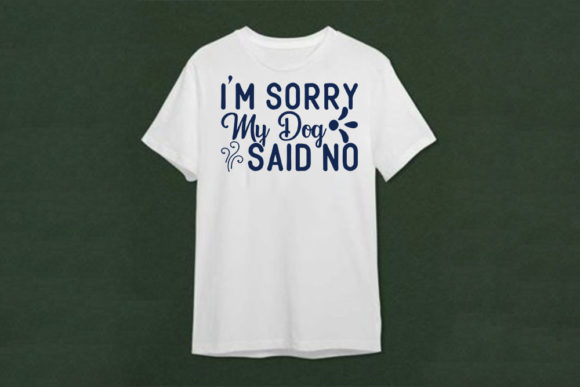
When I opened the I’m Sorry, My Dog Said No design for the first time, my instinct was to smile—and then immediately reach for a hoop. It’s got that rare balance: witty without being cutesy, bold without being aggressive, and just detailed enough to feel intentional, not cluttered. The layout is clean and centered, with friendly, slightly rounded lettering paired with a compact dog silhouette (likely a terrier or beagle type) sitting confidently beside the text. There’s no extra flourish—no bones, no paw prints, no speech bubbles—just quiet canine authority. That restraint makes it work beautifully as a machine embroidery design, especially for custom apparel and handmade products where clarity trumps complexity.
Real-World Test: Embroidering It on a Linen-Cotton Tote Bag
Last week, I stitched I’m Sorry, My Dog Said No onto a natural linen-cotton tote for a local boutique’s spring launch. Why this design? Because their customers love dry humor, pet-friendly branding, and tactile, high-quality handmade product presentation. I used medium-weight cutaway stabilizer, 40-weight polyester thread in charcoal gray and creamy off-white, and a 4" x 4" hoop. The result landed perfectly: legible at arm’s length, expressive up close, and unmistakably hand-finished—not digital, not generic. Customers paused at the display, chuckled, and asked, “Is that *your* dog?” That kind of engagement is gold for Etsy sellers and small shop owners. It doesn’t just decorate—it connects.
Where This Design Shines (and Where It Asks for Extra Care)
I’m Sorry, My Dog Said No excels on structured, stable surfaces: sweatshirt embroidery (especially crewnecks), embroidered patches, aprons, tea towels, and pillow covers. Its moderate height-to-width ratio fits neatly inside standard hoops without distortion. On baby embroidery—think onesies or burp cloths—it reads warmly, not sarcastically, thanks to its gentle line weight and open spacing between letters.
But here’s where attention matters: avoid using it on ultra-thin fabrics like lightweight rayon or single-knit tees without testing stitch density first. The letterforms have subtle curves and tight corners (especially in the lowercase “g” and “y”) that can blur if under-stabilized. On dark fabric, confirm your thread colors provide enough contrast—this isn’t a design that forgives muddy tonal choices. And while it works on caps, skip curved bill embroidery unless you’ve tested the file’s compatibility with your cap frame; some vector-based graphics don’t translate cleanly to 3D curvature without manual path adjustment.
Stitch Clarity Meets Customer Trust
What sets I’m Sorry, My Dog Said No apart from similar Graphics is how well it holds detail across scale. At 3.5", the dog’s ear and the curve of the “S” remain distinct—no merging, no bleeding. That directly impacts professionalism and buyer confidence. A customer buying a personalized gift expects crispness, not guesswork. If the “o” in “No” stitches as a blob, the whole joke collapses. I ran side-by-side tests on cotton twill and midweight denim: both held up, but only with appropriate tear-away + cutaway combo stabilizer. Skip that step, and the fill stitch areas (like the dog’s body) can pucker—undermining the handmade product’s premium feel.
Commercial Use & Creative Flexibility
This design lives comfortably in Print Templates and digital embroidery file workflows—but only if licensing allows. Since the ZIP includes EPS, SVG, PNG, and DXF files, it’s clearly built for versatility: use the SVG for Cricut or Silhouette cutting, the PNG for printable mockups, the EPS for vector editing, and the DXF if you’re prepping for CNC or laser engraving. That multi-format support is a huge plus for craft business owners juggling embroidery, sublimation, and screen printing. Just remember: owning the files ≠ automatic commercial rights. Always verify license terms before listing finished products on Etsy or bundling I’m Sorry, My Dog Said No into a digital embroidery file pack.
Practical Designer Notes You’ll Actually Use
- Always test on scrap fabric first—especially if pairing with textured weaves or stretchy knits.
- Review stitch density in your embroidery software. If fill areas look overly dense, reduce density by 5–8% to prevent stiffness on apparel.
- Confirm hoop size compatibility. While it fits standard 4" hoops, double-check if you’re scaling beyond 120%—some curves may need re-digitizing.
- Inspect small details at 200% zoom: the dot over the “i”, the tail tip of the dog, and spacing between “My” and “Dog” should all remain intentional, not collapsed.
- Test black-and-white mockups before finalizing color palettes—this design relies on shape recognition, not shading.
- Compare light and dark fabric backgrounds in your design software. What reads cleanly on ivory may vanish on navy without thread contrast tweaks.
- Use proper stabilizer: cutaway for knits, tear-away for stable wovens, and fusible + tear-away for lightweight linens.
- Check dual-use readiness: does the design work equally well for personal keepsakes *and* client-facing commercial embroidery? With I’m Sorry, My Dog Said No, yes—if stabilized and scaled thoughtfully.
Final Thought: Not Just a Gag—A Brand-Ready Asset
I’m Sorry, My Dog Said No isn’t just another novelty graphic. It’s a conversation starter with craftsmanship baked in. For holiday embroidery, it adds warmth without cliché. For boutique branding, it signals approachability and wit. For the Etsy seller launching a pet-themed line, it’s a ready-made anchor design—scalable, licensable (pending verification), and emotionally resonant. It won’t solve every embroidery challenge, but when matched to the right fabric, stabilizer, and intention, it delivers exactly what handmade product creators need: authenticity, clarity, and quiet confidence. That’s why I keep it in my go-to folder—not as filler, but as finish.